
Last updated September 10, 2026
Level 1 sweep and inspection to the NFPA 211 annual standard - flue, crown, cap, and flashing checked and photographed
Chimney sweep logs do not sweep chimneys. They loosen some creosote - which then falls where a brush and vacuum still have to collect it.



 Before
 After
After Before
 After
After Before
 After
AfterChimney Cleaning & Sweep Maintenance Checklist for Fredericksburg Homeowners
Here’s a problem with most “chimney maintenance checklists”: they’re written by content teams, not sweeps. They list “check for creosote” without telling you where creosote hides first (the smoke chamber, not the flue) or what color signals immediate danger versus routine buildup. In Fredericksburg, where our freeze-thaw cycles chew through mortar joints and our mature oak canopy drops debris year-round, a backwards checklist can miss the roof-level failure that becomes a $3,000 rebuild. This guide sequences every inspection point the way a certified sweep actually works: crown to firebox floor, exterior to interior, with seasonal timing that matches how Fredericksburg homeowners actually use their hearths.
Quick Answer
A proper chimney maintenance checklist for Fredericksburg homeowners follows a top-down inspection sequence: chimney cap and crown first, then flashing and masonry, then the flue liner, smoke chamber, damper, and firebox floor. Most homeowners can safely check the cap screen, damper operation, and firebox floor themselves, but liner condition and smoke chamber creosote require a Level-2 camera inspection by a certified sweep. Schedule Chimney Cleaning & Sweep services annually before burning season, with additional mid-season checks if you burn more than three cords of oak or hickory per winter.
Table of Contents
- Roof-Level Inspection: Cap, Crown, and Flashing
- Masonry and Structural Check
- Flue Liner and Smoke Chamber
- Firebox, Damper, and Hearth
- Seasonal Timing: When to Check What
- What You Can Check Yourself vs. What Needs a Sweep
- Record-Keeping for Your Chimney History
- What Professional Maintenance Costs in Fredericksburg
Roof-Level Inspection: Cap, Crown, and Flashing
Every professional sweep starts at the top. Not because it’s dramatic, but because what fails up here predicts everything you’ll find below. Water is a chimney’s enemy in Fredericksburg, and it enters at the roof line more often than anywhere else.
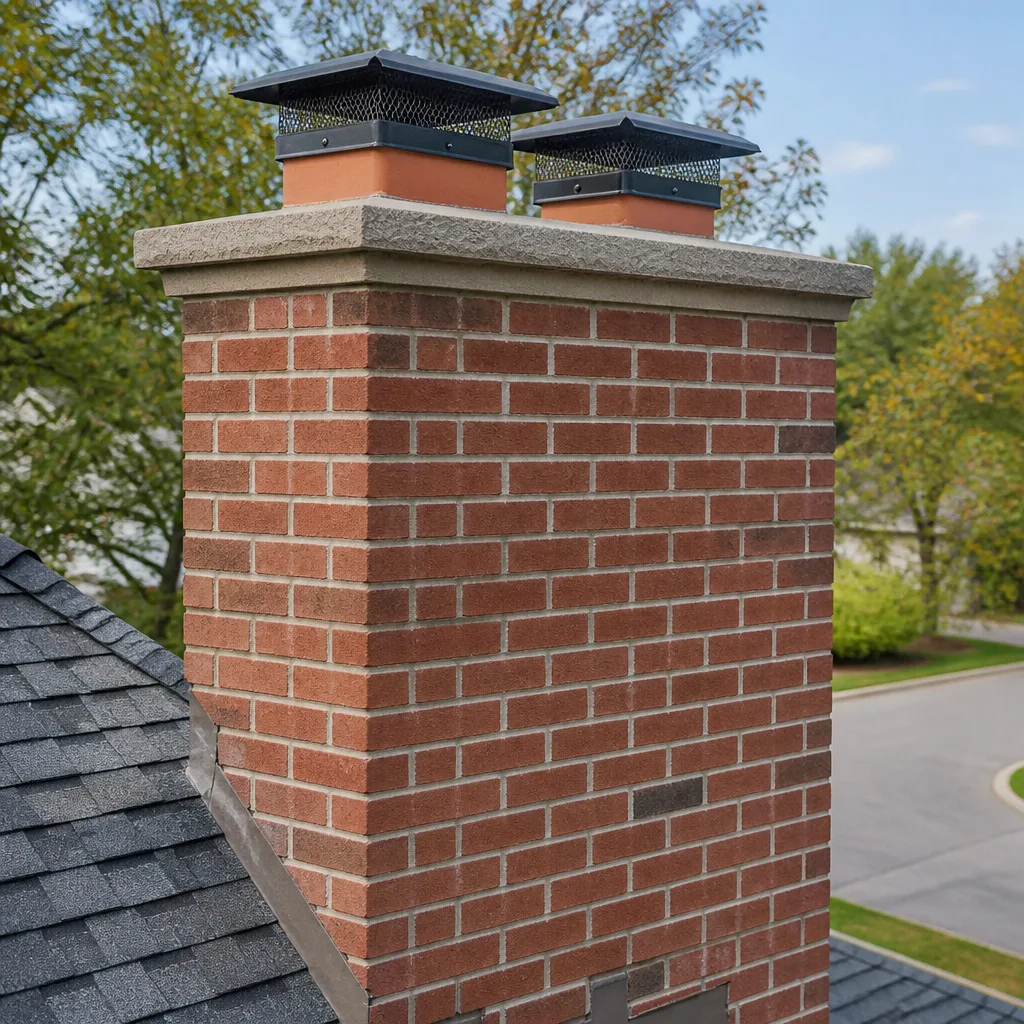
The chimney cap is your first defense. A proper cap with a stainless-steel mesh screen keeps squirrels, raccoons, and the starlings that nest in Fredericksburg’s historic districts from building combustible homes in your flue. Look for these specific points:
- Mesh screen intact with gaps no larger than 3/4 inch - larger openings let embers escape and animals enter
- Cap seated firmly, not tilted by winter ice or summer wind
- No rust streaks running down the flue tile, which indicate cap failure or missing cap altogether
- Proper overhang: the cap should extend past the flue tile edge by at least one inch to shed water
The crown is the concrete slab that tops a masonry chimney. In Fredericksburg, where we see 15 to 20 freeze-thaw cycles each winter, crown cracks are epidemic on homes built before 1990. Hairline cracks let water penetrate; by spring, that water has expanded, deepened the crack, and begun dissolving the mortar beneath. A crown should slope away from the flue opening at least 1/4 inch per foot. If water pools on top, the crown was poured flat or has settled. We replace failed crowns with poured concrete or pre-formed Gelco units that shed water properly.
Flashing - the metal seal where chimney meets roof - is the most common leak source we find in chimney repair calls across Fredericksburg. Step flashing should tuck behind siding or brick courses; counter-flashing should be embedded in mortar joints, not caulked to the face. Caulk fails. Mortar doesn’t. In the Ferry Farm and Chatham Heights neighborhoods, where many roofs are 20-plus years old, we regularly find flashing that was “repaired” with roofing cement that has cracked and peeled within two seasons.
What to record: Date of cap installation, crown condition (sound, hairline cracks, spalling, or failed), flashing material and condition, any vegetation growth (moss indicates chronic moisture).
Masonry and Structural Check
Below the crown, the chimney stack tells the story of decades of weather exposure. Fredericksburg’s clay-rich soils and humid summers create conditions that stress masonry differently than drier inland climates.
Brick and mortar joints: Sound mortar should be recessed slightly from the brick face, with consistent color. If mortar is flush or protruding, it’s likely a Portland cement repointing job that will trap moisture and accelerate deterioration. Proper repointing uses Type N or Type O mortar that matches the original lime-based mortar’s permeability. In the historic district and surrounding neighborhoods like Kenmore and Mary Washington, we see too many chimneys repointed with hard mortar that has spalled the brick faces within five years.
Spalling brick - faces flaking off - means water has entered, frozen, and expanded. Once spalling starts, it accelerates. A single spalled brick in a prominent course is often the visible tip of internal saturation. Tap suspect bricks lightly with a hammer handle; a hollow sound indicates delamination behind the face.
Chimney lean or separation from the house is a structural emergency. In Stafford County and southern Fredericksburg, where some developments were built on fill soils during the 1980s and 1990s, we’ve seen chimneys tilt two inches or more from plumb. The gap at the roofline widens, flashing tears, and water enters the wall cavity. This requires immediate professional evaluation - not next month, before the next rain.
Cricket or saddle: On chimneys wider than 30 inches (common with multiple flues), a properly built cricket diverts water around the chimney. Missing or poorly flashed crickets cause the valley behind the chimney to pond water. We see this constantly on the larger homes in Falmouth and the estates along the Rappahannock.
What to record: Mortar joint condition by elevation, any spalled bricks with course and position noted, lean measurement if present, cricket condition, date of last repointing.
Flue Liner and Smoke Chamber
This is where amateur checklists fail. They tell you to “look up the flue” without explaining what you’re seeing, or they skip the smoke chamber entirely because it’s invisible without a mirror or camera.
The flue liner is a clay tile, stainless steel, or refractory cement conduit that contains combustion gases and protects the surrounding masonry from heat. In Fredericksburg, we estimate 60% of pre-1985 homes have unlined chimneys or damaged clay tile liners. Building codes have required liners since the mid-1980s, but many older homes were never upgraded.
Here’s what a Level-2 camera inspection reveals that you cannot see from below:
- Tile cracks: Vertical cracks in clay tile are thermal-shock damage from a chimney fire or rapid heating. Horizontal cracks indicate structural settling. Both allow heat and gases to reach combustible framing.
- Tile gaps: Missing mortar between tile joints, or tiles that don’t align properly, create leakage paths. A 1/2-inch gap at a joint is enough to allow creosote accumulation in the chimney cavity.
- Glazed creosote: The hard, shiny, black or brown deposit that forms when fresh creosote is heated repeatedly. It cannot be removed with standard brushing. We treat glazed creosote with Copperfield’s Poultice Creosote Remover or remove it mechanically with chains or rotary devices.
- Spalled tile interior: Flaking clay tile surfaces reduce flue diameter and create turbulence that worsens creosote deposition.
The smoke chamber is the inverted funnel above the damper that channels smoke into the flue. It’s the most neglected component in chimney anatomy, and it’s where creosote deposits first and thickest. The National Fire Protection Association (NFPA) requires smoke chambers to be parged smooth with refractory mortar. Most aren’t. Rough, corbeled brick in the smoke chamber creates turbulence, slows draft, and provides infinite surface area for creosote accumulation.
In our chimney cleaning work throughout Fredericksburg, we regularly find smoke chambers with 1/4-inch or greater creosote buildup while the flue above shows only light soot. The smoke chamber is also where many chimney fires start - the restricted space and high turbulence create the perfect conditions for ignition.
What homeowners can check: Shine a flashlight up past the damper. If you see rough brick, mortar falling, or shiny black deposits, call for a camera inspection. Do not attempt to clean the smoke chamber yourself - the geometry makes proper brushing nearly impossible without specialized tools, and disturbing glazed creosote without proper containment risks a fire or toxic exposure.
What to record: Liner type and installation date, last camera inspection date and findings, smoke chamber condition, any creosote removal method used.
Firebox, Damper, and Hearth
The firebox is where you see the fire, but it’s also where the most direct heat stress occurs. Proper construction and maintenance here prevent house fires and carbon monoxide intrusion.
Firebox floor and walls: Look for cracked or missing firebrick, deteriorated mortar joints, and rust stains that indicate water entry from above. The firebox should be built with firebrick and refractory mortar rated to 2,000°F or higher. Standard brick and Portland mortar will fail quickly. In factory-built fireplaces (common in homes from the 1970s through 1990s), the metal firebox should show no warping, cracks, or rust-through. Replacement panels for factory-built units are model-specific; we source from Olympia Chimney and other manufacturers, but some older models are obsolete.
Damper operation: The damper should open fully, close tightly, and operate smoothly. A damper that won’t fully open restricts draft and causes smoke backup. A damper that won’t fully close wastes heat when the fireplace isn’t in use. In Fredericksburg’s climate, a leaky damper can cost $200 or more in heating energy per winter. We install top-sealing dampers with stainless-steel caps that seal at the chimney top, eliminating the heat loss path entirely.
Hearth extension: The non-combustible surface in front of the fireplace must extend at least 16 inches in front and 8 inches to each side (more for larger openings). Raised hearths should have proper support; we’ve seen cracked hearths in homes near the university where settling has created a trip hazard and a fire risk as gaps open to combustible subflooring.
Glass doors and screens: These are safety devices, not decorations. Glass doors should be open during fire starting to prevent thermal shock, then can be closed once the fire is established. Mesh screens catch rolling logs and sparks. Check that door gaskets are intact and hinges operate smoothly.
What to record: Firebrick condition, damper type and operation, hearth dimensions and condition, door/screen condition.
Seasonal Timing: When to Check What
Fredericksburg’s burning season runs roughly from mid-October through March, with peak demand around Thanksgiving and the December holidays. Timing your maintenance to this rhythm prevents the October rush and catches problems before they become emergencies.
Pre-Season Startup (September to Early October)
- Professional sweeping and Level-2 inspection - book by Labor Day to guarantee pre-season scheduling
- Roof-level inspection: cap, crown, flashing after summer storms
- Test damper operation after months of disuse
- Check firebox for debris, animal nests, or water staining that occurred over summer
- Stock proper fuel: seasoned hardwood (oak, hickory, maple) with 20% moisture or less
In Fredericksburg, the fireplace services schedule fills by mid-September most years. Homeowners who wait until the first cold snap often face two-week delays. A chimney fire in November doesn’t wait for your appointment.
Mid-Season Spot-Check (January)
- Visual firebox inspection for cracked brick or mortar
- Check cap screen for ice buildup after freeze events
- Monitor for smoke spillage or draft problems that indicate partial blockage
- Empty ash pit if equipped - don’t let ashes accumulate above the grate level
Mid-season is also when we see the most emergency calls from homeowners who burned green wood or construction debris over the holidays, as explained in The Complete Guide to Chimney Cleaning in Fredericksburg. The creosote buildup from a single weekend of burning unseasoned pine can equal a month of proper hardwood use.
Post-Season Shutdown (March to April)
- Final cleaning if you’ve burned more than two cords
- Close damper tightly to prevent conditioned air loss
- Inspect for water entry during spring rains - this is when flashing and crown leaks reveal themselves
- Document the season: cords burned, fuel type, any operational issues
Spring inspection is undervalued. The combination of winter’s thermal stress and spring’s driving rains exposes weaknesses that were invisible in dry fall weather. We find more crown and flashing failures in April than in October.
What You Can Check Yourself vs. What Needs a Sweep
We’re plain about this because we’ve seen the aftermath of ambitious DIY. Some tasks are genuinely safe for homeowners. Others require training, tools, and the judgment that comes from inspecting thousands of chimneys.
Safe for Homeowners
- Cap screen check: From the ground with binoculars, or from a ladder if you’re comfortable and the roof is low-pitch. Look for gaps, rust, or tilting. Don’t climb onto the roof if you’re uncertain - falls from roof height are a leading cause of home injury.
- Damper operation: Open and close fully. Listen for scraping that indicates off-track operation or debris interference.
- Firebox floor: Visual inspection for cracks, missing brick, ash accumulation, or debris. Remove ashes to a metal container with a tight lid; store outside on non-combustible surface for at least three days before disposal.
- Smoke test: With damper open, light a match and blow it out. Watch smoke rise into the flue. If it spills into the room, you have a draft problem - call before using the fireplace.
- Hearth and surround: Check for cracks, gaps, or combustible material too close to the opening. Clearances to mantels and trim should meet manufacturer specifications.
Requires a Certified Sweep
- Any roof-level work beyond visual inspection from a ladder - crown repair, cap installation, flashing repair involves fall risk and proper material application
- Flue liner camera inspection - the specialized equipment and interpretation training are not homeowner-accessible
- Smoke chamber cleaning and parging - confined space, toxic exposure risk, and technical difficulty
- Creosote removal beyond light soot brushing - glazed creosote requires chemical or mechanical treatment that risks fire if done improperly
- Damper repair or replacement - involves working at height and proper sizing
- Any work involving gas lines or gas log sets - carbon monoxide risk and code requirements
The safety caveat: Chimney work involves heights, confined spaces, and genuinely dangerous conditions. A flue liner collapse or chimney fire during DIY cleaning can expose you to toxic gases, falling masonry, or uncontrolled fire spread. The money saved on a professional sweep is quickly lost - multiplied - on a hospital bill or house fire deductible.
Record-Keeping for Your Chimney History
A documented maintenance history protects your home’s value and your family’s safety. When you sell, a buyer’s inspector will ask for it. When we return for service, it tells us what’s changed. Here’s a plain-English template we recommend Fredericksburg homeowners maintain:
Chimney Maintenance Log - [Address]
| Date | Service Performed | Provider | Findings | Recommended Follow-Up |
| Example: 10/15/2024 | Level-2 inspection, sweep, camera | Hearthstone Chimney Co. | Light soot in flue; 1/8″ creosote in smoke chamber; crown hairline crack | Repoint crown spring 2025; next sweep 10/2025 |
Additional records to file:
- Installation dates for liner, cap, damper, or insert
- Fuel source and quantity burned per season
- Any operational issues: smoke spillage, odor, draft problems, unusual sounds
- Photos of roof-level components, taken annually from the same angle
- Copies of all inspection reports with technician notes
Keep this with your home maintenance files, not buried in email. The next owner - or the next sweep - should be able to reconstruct your chimney’s entire history in five minutes.
What Professional Maintenance Costs in Fredericksburg
Price transparency matters. Here’s what Fredericksburg homeowners can expect for professional chimney services, based on our local market:
| Service | Typical Range | What Affects Price |
| Chimney sweep with Level-1 inspection | $175 - $275 | Number of flues, accessibility, amount of creosote |
| Level-2 inspection with camera | $250 - $400 | Height of chimney, number of appliances served, report detail |
| Chimney cap installation (stainless steel) | $350 - $650 | Flue size, cap style, number of flues |
| Crown repair or rebuild | $500 - $1,800 | Extent of damage, access difficulty, material (pour vs. pre-formed) |
| Flashing repair | $400 - $1,200 | Linear feet, roof pitch, whether step flashing must be replaced |
| Smoke chamber parging | $1,200 - $2,500 | Chamber size, access, extent of damage |
| Stainless steel liner installation | $2,500 - $5,500 | Flue length, diameter, number of bends, appliance type |
Our Hearthstone Chimney Co. home page details our current offers: $89 Seasonal Tune-Up, $50 off any repair over $250, free second opinion on any written estimate, and a permanent 5% senior and veteran discount. Every estimate is firm before work begins - the number we quote is the number on the invoice.
Homes in Fredericksburg’s historic district or with steep roof pitches may fall at the higher end of these ranges due to access requirements. We evaluate each chimney individually and explain exactly what drives the price before you commit.
Common Mistakes to Avoid
- Starting inside and working up. This reverses the logic of water damage. The stain on your firebox ceiling almost always originates at the crown or flashing, not the damper. Inspect top-down to find the true source.
- Burning unseasoned wood. Oak and hickory need 18 to 24 months of covered drying in Fredericksburg’s humidity. Wood sold as “seasoned” at gas stations in November rarely is. Buy in spring, stack with air circulation, cover the top only.
- Ignoring the smoke chamber. It’s invisible without effort, so it’s ignored until it’s a hazard. Request that your sweep specifically address smoke chamber condition and document it.
- Using the fireplace as an incinerator. Gift wrap, cardboard, and construction scraps create intense, uncontrolled burns that damage liners and deposit airborne toxins. The draft is designed for wood, not variable fuels.
- Skipping annual inspection because “it looks fine.” Creosote buildup, liner cracks, and crown deterioration progress invisibly. By the time you see evidence inside, the damage is advanced.
- Hiring based on lowest price alone. In Fredericksburg’s competitive market, some operators offer “$99 sweeps” that last 20 minutes and miss critical conditions. A proper Level-2 inspection takes 45 minutes to 90 minutes. Price is what you pay; value is what you get when the chimney fire doesn’t happen.
- Delaying crown repair. A $600 crown rebuild prevented becomes a $3,000 chimney rebuild required. Water is patient and relentless.
When to Call a Professional
Call a certified sweep immediately if you notice smoke entering the room, a strong tar odor during humid weather, visible cracks in the firebox, bricks falling into the fireplace, or water stains on walls or ceilings near the chimney. After any chimney fire - indicated by a roaring sound, dense smoke, or flames visible at the chimney top - do not use the fireplace until a Level-2 inspection confirms liner integrity. The thermal shock of even a small chimney fire can crack clay tile liners, creating a path for future fires to reach combustible framing.
Hearthstone Chimney Co. offers free estimates in Fredericksburg. Call (540) 596-5531 and a live person will answer, any hour, any day. We’ll schedule a Level-2 camera inspection, show you photos you can see, and give you a plain-English verdict on what needs attention now, what can wait, and what you can safely monitor yourself.
Frequently Asked Questions
A professional chimney sweep with Level-1 inspection in Fredericksburg typically costs $175 to $275, while a Level-2 inspection with camera runs $250 to $400. The exact price depends on the number of flues, chimney height, and the amount of creosote buildup. Hearthstone’s $89 Seasonal Tune-Up offer covers basic maintenance for qualifying systems. Call (540) 596-5531 for an exact quote - estimates are free.
The National Fire Protection Association recommends annual inspection for all chimneys, and sweeping as needed based on creosote accumulation. In Fredericksburg, where oak and hickory are common fuel sources, most homeowners who burn regularly need sweeping once per year before burning season. If you burn more than three cords per winter, or use unseasoned wood, mid-season inspection may be warranted. The 1/8-inch rule is reliable: if creosote buildup exceeds 1/8 inch, sweep before the next fire.
You need a new liner if your existing liner is cracked, missing sections, or absent entirely; if you’ve changed fuel types (wood to gas, or vice versa); or if your chimney serves a modern appliance that requires a specific liner diameter for proper draft. Not every recommendation for liner replacement is legitimate. At Hearthstone, we document liner condition with camera photos you can see, explain the specific code or safety reason for replacement, and show you exactly where the damage is. If a sweep recommends liner replacement without camera evidence, get a second opinion - ours is free.
Skipped maintenance leads to creosote accumulation that fuels chimney fires, liner deterioration that allows heat and combustion gases to reach combustible framing, and water intrusion that destroys masonry from the inside. In Fredericksburg, we’ve rebuilt chimneys that could have been preserved with timely crown repair, and we’ve documented house fires that started in neglected flues. The cost of annual maintenance is a fraction of emergency repair or insurance deductible. More critically, carbon monoxide from a compromised flue is odorless and potentially fatal.
You can perform light firebox cleaning and ash removal safely. You cannot properly inspect or clean the flue liner, smoke chamber, or roof-level components without training, equipment, and fall protection. Virginia does not license chimney sweeps at the state level, but certification through the Chimney Safety Institute of America (CSIA) or National Fireplace Institute (NFI) indicates verified training. For your safety and your home’s insurability, hire a certified professional for annual service. The photos and documented report also protect you in real estate transactions.
A Level-1 inspection is a visual examination of readily accessible portions of the chimney, appropriate for annual maintenance when no changes have been made to the system. A Level-2 inspection includes everything in Level-1 plus camera examination of the flue interior, accessible portions of the attic and basement, and inspection of the chimney exterior - required when property is changing hands, after a chimney fire or weather event, or when the fuel type or appliance is changed. In Fredericksburg’s older housing stock, we recommend Level-2 for any first-time service or when maintenance history is unknown.
Yes. Fredericksburg’s freeze-thaw cycles, humid summers, and mature tree canopy create specific stresses. Winter temperature swings cause crown and mortar damage as water repeatedly freezes and expands. Summer humidity slows wood seasoning and promotes moss and algae growth on masonry. Oak and poplar overhangs drop leaves and debris that clog caps and gutters. Our inspection sequence accounts for these local conditions, and we schedule preventive maintenance to precede the seasons that cause the most damage.
The Bottom Line
A useful chimney checklist works from crown to firebox, matches the actual sequence of professional inspection, and separates what you can check from what requires a certified sweep with a camera. Seasonal timing in Fredericksburg means pre-season sweeping by October, mid-season vigilance in January, and post-season documentation in April. Record-keeping protects your investment and your safety. The cost of professional maintenance is modest compared to the cost of delayed repair - and the risks of fire or carbon monoxide exposure are not hypothetical. They’re the reason we answer the phone 24 hours a day.
Done right - and we stand behind it.
Written by Russell Haines, Owner at Hearthstone Chimney Co., serving Fredericksburg since 2014.